JULY 2025

Tucked away in the heart of Warwickshire lies the quiet village of Ryton-on-Dunsmore — a place where few today would guess at its deep medieval connections to one of the most powerful military-religious orders of the Crusading age: the Knights Hospitallers.
Though little is recorded in mainstream history books, Ryton-on-Dunsmore once held a significant estate of the Hospitallers. This knightly order, founded to provide care for sick pilgrims in the Holy Land, eventually became a military force defending Christian interests across Europe and the Middle East. Their presence in Ryton is now a silent echo — but the clues remain if you know where to look.
A Gifted Land with Ancient Roots
The land at Ryton-on-Dunsmore was first gifted in 1043 to the Prior of Coventry by Earl Leofric — the very same Leofric of Lady Godiva fame. The name ‘Ryton’ is thought to derive from the cultivation of rye in the area, and by the time of the Domesday survey in 1086, the manor was held by a man named Alwin. It was a thriving settlement, boasting 23 villagers, 8 smallholders, a priest, and a working mill. The manor supported 10 ploughlands and 8 men’s plough teams, 12 acres of meadow, and a mill powered by the River Avon — an impressive estate by medieval standards.
For several centuries, the land remained in the hands of the Arden (or Ardene) family, one of Warwickshire’s oldest and most noble lineages. Eventually, the manor passed into the possession of the Knights Hospitallers.
The Heart of the Manor: Church and Commandery
At the centre of the Hospitallers’ Ryton estate stood the Church of St Leonard, which they not only held the advowson (the right to appoint clergy) of, but also formally appropriated — bringing the church directly under the control of the order. Immediately to the south of the medieval church stood the Hospitaller manor house, serving as a commandery — both administrative centre and residence — for their Warwickshire lands.

Built on the site of the original Saxon manor, this commandery sat at the heart of the medieval village, which clustered around the church and manor as a classic feudal settlement. The manor would have overseen the estate’s agricultural production and served as a place of hospitality for travellers and pilgrims, especially those journeying along the nearby Roman Fosse Way — a key route connecting Exeter and Lincoln.
The Silent Cross of Knightlow Hill
One of the few physical remnants of this Hospitaller past lies just a mile from the church: a mysterious stone base believed to be the remains of a medieval wayside cross. Located at Knightlow Hill, it likely marked the boundaries of Hospitaller land. In medieval times, crosses such as these served not only religious functions but also legal and administrative ones — indicating land exempt from tithes, as held by military orders like the Hospitallers and their Templar counterparts.
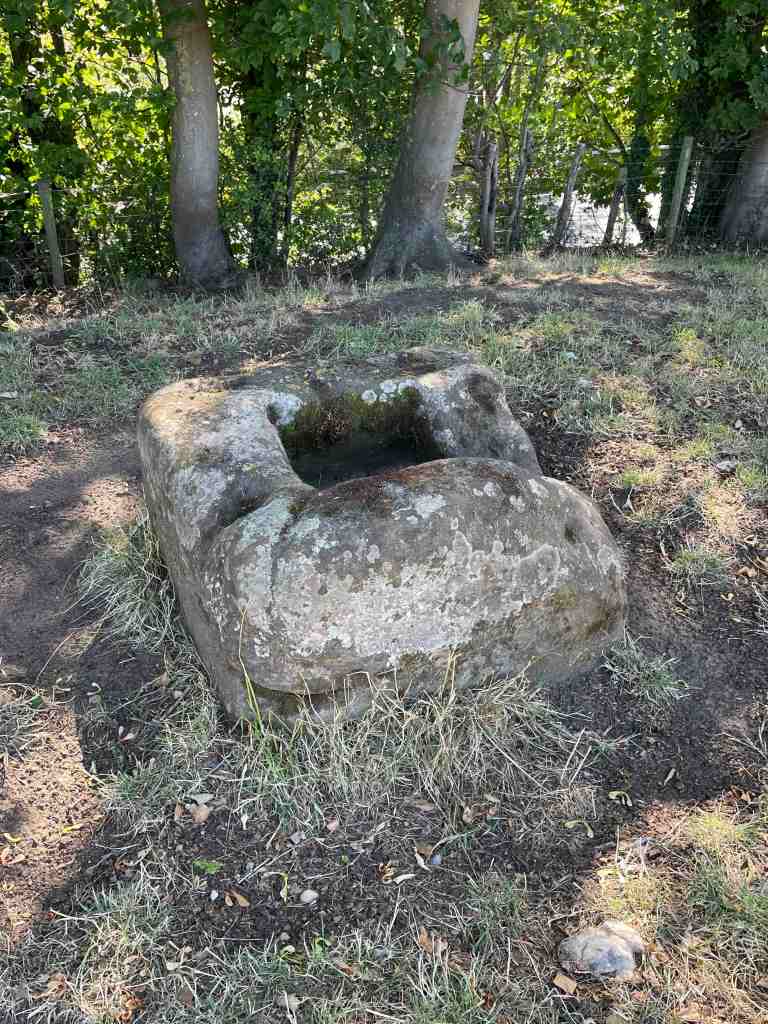
Though its shaft has long vanished, the base endures, much like the intact shaft of the Knights Templar cross at Templeton in Pembrokeshire. Today, the site is associated with the curious and ancient “Wroth Silver” ceremony, which still takes place every November — possibly a remnant of medieval customs linked to Hospitaller tenure and dues.
The River Avon and the Mill of Cloth
Another clue to the scale and industry of the Hospitallers’ estate lies half a mile from the church, on what was once the 11th hole of Brinklow Golf Course. Hidden in the overgrowth, the remnants of a leat and weir system suggest the site of a former water mill — likely one of several along the River Avon in the vicinity.

Records from 1630 identify a fulling mill here — used to clean and thicken woollen cloth. But given the strategic location and medieval context, it’s probable that this 17th-century mill was built atop a much older structure, dating back to the Hospitallers’ occupation. The order would have needed such facilities to process the wool and cloth produced on their 300+ acres of land.

A Legacy in Silence
Today, little remains above ground to tell the story of the Knights Hospitallers at Ryton-on-Dunsmore. The manor house is gone. The church, though still standing, has undergone centuries of change. The tithe cross lies weathered and nearly forgotten. The mills are quiet, reclaimed by nature.
And yet, these stones still whisper of a time when Ryton was part of a wider network of Hospitaller commanderies — raising funds for the Crusades, offering shelter to pilgrims, and anchoring a global order to this quiet corner of England.
In the landscape, in the ceremony of Wroth Silver, in the names and fields and streams — their legacy endures.
Sources:
- Local oral traditions and historical land surveys
- Domesday Book entries (1086)
- Parish records and medieval land grants
- Comparative analysis of Templar and Hospitaller land markers in England and Wales
Interested in uncovering more about Knights Hospitallers, Knights Templar’s and the order of St Lazarus hidden history? check in our sister website www.thetemplars.co.uk for more information on the Knights Templar, Knights Hospitallers and Order of St.Lazarus in the United Kingdom
Learn More about the Knights Hospitallers in the UK on our main website by clicking here
Check Out out Knights Gift Store for your replica Knights Templar, Hospitaller and Order of St Lazarus Armour, weapons clothes & gifts by clicking here
 TheTemplars.Co.Uk