AUGUST 2025

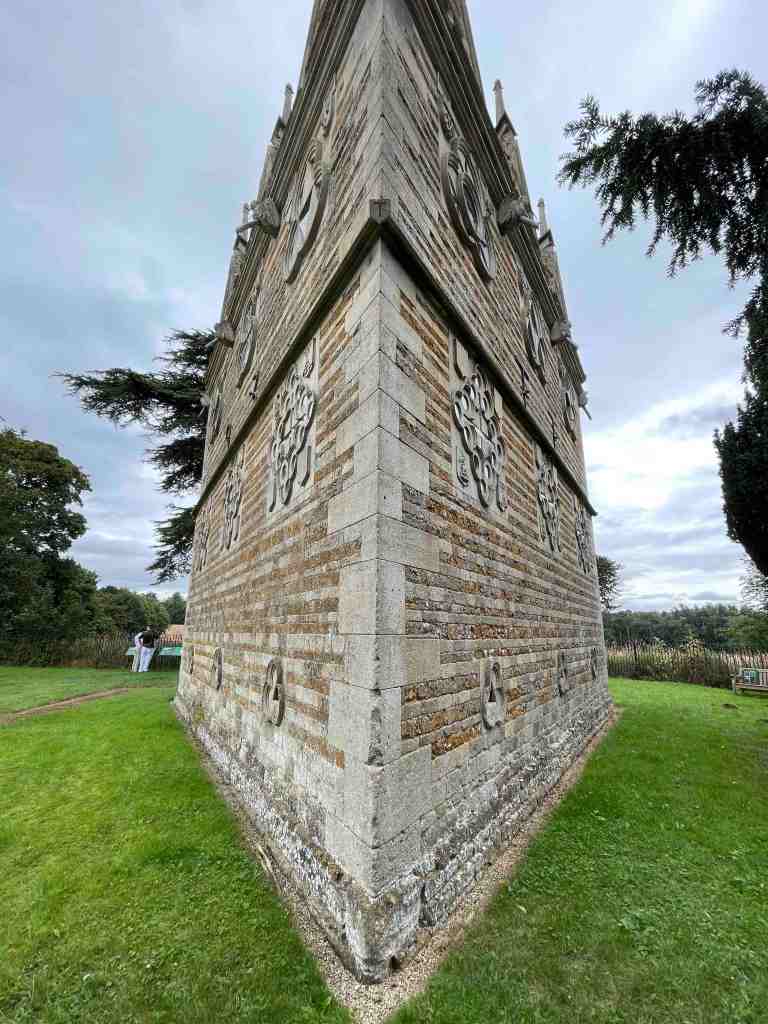
In the quiet fields of Northamptonshire stands one of England’s most unusual monuments: the Triangular Lodge at Rushton, built between 1593 and 1597 by Sir Thomas Tresham. At first glance, it looks like an eccentric folly. In reality, it is a coded declaration of faith and a defiant act of devotion.
From Knights Hospitallers to Elizabethan Rebels
Tresham’s Catholic roots ran deep. He was the grandson of Sir Thomas Tresham, the last Grand Prior of the Knights Hospitallers in England—a medieval military order founded to protect pilgrims and defend the Christian faith. The Hospitallers were renowned for their vows of service, chastity, and obedience, and their mission was inseparable from the defense of Catholicism. After Henry VIII dissolved the order, the family’s position was stripped away, but its religious convictions remained intact.
Sir Thomas Tresham (the younger) inherited not only this legacy but also its risks. In Protestant Elizabethan England, Catholicism was illegal. Tresham refused to attend Anglican services and was repeatedly fined and imprisoned. The Triangular Lodge became his answer: a building that celebrated the faith he could not publicly practice.

The Power of Three
The Lodge’s design revolves around the number three, symbolizing the Holy Trinity—Father, Son, and Holy Spirit.
- Three sides, each exactly 33 feet long (Christ’s age at the crucifixion).
- Three triangular gables.
- Three floors, each layered with different religious meanings.
- Trefoil windows and decorative patterns repeating the sacred number.
Tresham claimed his inspiration struck during contemplation, when he heard three loud knocks, “as if by an iron hammer,” which he interpreted as a divine call to build.
Faith Carved in Stone
The building is covered in inscriptions, carvings, and symbols—an architectural catechism.

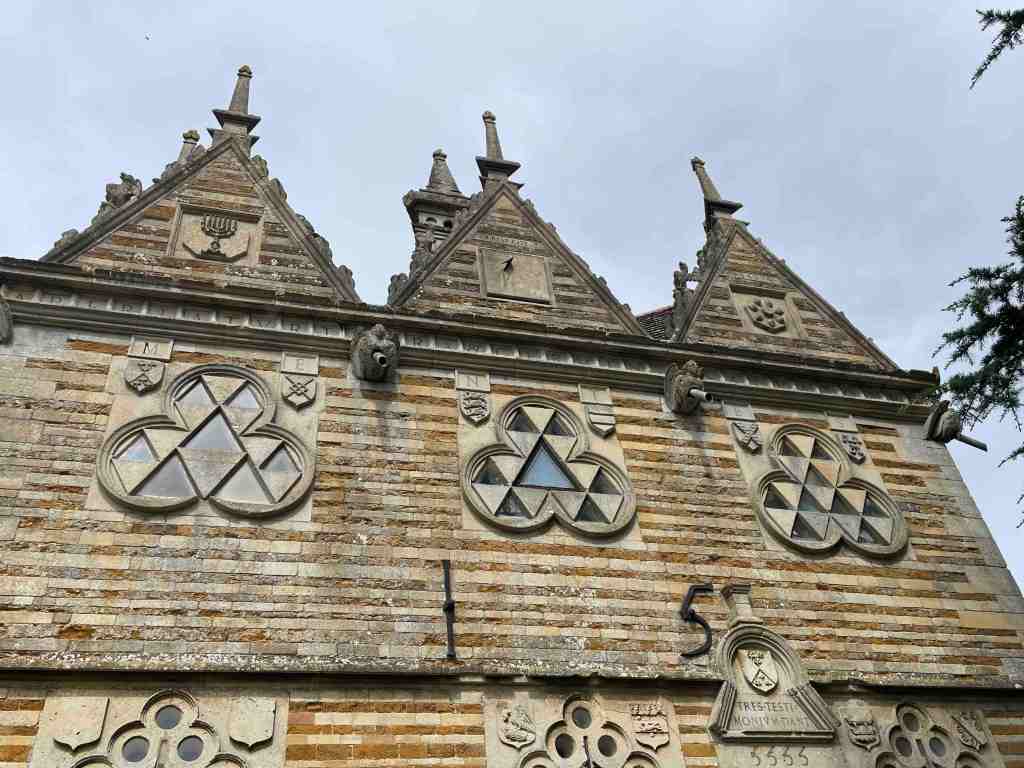
- Images on the Gables:
- A pelican feeding her young (a symbol of Christ’s sacrifice).
- A dove and chicks (the Virgin Mary).
- A seven-branched candlestick (a possible reference to the Apocalypse).
- Nine angelic gargoyles, their letters forming coded prayers such as SSSDDS—the initials of Sanctus Sanctus Sanctus Dominus Deus Sabaoth, sung during Mass.
- Inscriptions and Codes:
Three 33-letter Latin phrases wrap around the walls:- Consideravi opera tua, Domine, et expavi – “I have considered thy works, Lord, and been afraid.”
- Quis separabit nos a charitate Christi? – “Who shall separate us from the love of Christ?”
- Aperiatur terra, et germinet Salvatorem – “Let the earth open and bring forth salvation.”
- “Tres” was both a reference to the Trinity and Tresham’s own nickname.
- Scholars suggest 5555 could encode “Jesus-Maria-Salus-Mundi” (Jesus, Mary, Saviour of the World), or reflect Tudor-era calculations of creation (3962 BC + 1593 = 5555).


Symbolism Within
Inside, the meaning deepens:
- The lowest floor, dark and narrow, may symbolize Hell.
- The middle floor, broader and brighter, represents Earth.
- The top floor, filled with light, reflects Heaven.
Every angle, window, and inscription reinforces the theological vision.
Legacy and Reflection
Tresham’s commitment to Catholicism carried into the next generation. His son, Francis, became involved in the Gunpowder Plot of 1605, an attempt to assassinate King James I. Sir Thomas himself died that same year, having seen the Triangular Lodge completed—the only building he designed that survives today.
The Lodge reflects both personal devotion and a wider tradition inherited from the Knights Hospitallers: a belief that faith was worth defending, even at great personal cost. Today, it stands as a reminder of how architecture can embody conviction, turning stone into a manifesto.
Learn More about the Knights Hospitallers in the UK on our main website by clicking here
Check Out out Knights Gift Store for your replica Knights Templar, Hospitaller and Order of St Lazarus Armour, weapons clothes & gifts by clicking here
 TheTemplars.Co.Uk