
The Knights Templar and Hospitaller in Suffolk
Suffolk was an important county for both the Knights Templar and the Knights Hospitaller, combining rich farmland, valuable rents, mills, churches and access to the east coast ports.
The Templars were active in Suffolk from the 12th century until their suppression in 1312. One of their most significant sites was Dunwich, then a major medieval port. At Richendone, near the town and harbour, they held a preceptory with a chapel, messuages, rents and a windmill. After 1312, this passed to the Hospitallers and continued as a camera until the Dissolution. The site, like much of medieval Dunwich, was later lost to the sea.
Other Suffolk holdings included Dingle, likely connected with the Dunwich estate, and East Bergholt, where the later names St John’s and The Commandery preserve the memory of Hospitaller ownership after former Templar lands passed to the Order of St John.
For both orders, Suffolk was valuable because it provided income and resources to support their wider religious, charitable and crusading work. Its coastal position also linked their estates to trade and movement across the North Sea.
Though many physical remains have vanished, the Templar and Hospitaller presence in Suffolk survives in records, place-names and landscapes once central to medieval East Anglia.
Just as it is today, Somerset in medieval times was a land well-suited for agriculture. Its rich soils—especially across the Somerset Levels and Moors—and its patchwork of rolling hills and wetlands made it an ideal place for farming and livestock rearing. Cattle and sheep thrived in this predominantly pastoral landscape, providing a vital source of income and sustenance.
It’s little wonder, then, that the Knights Templar—one of the most powerful and mysterious military orders of the medieval world—saw the value in establishing themselves here. As part of their vast European network, the Templars acquired numerous manors and farms across Somerset to support their mission and fund their campaigns in the Holy Land.
By 1187, the Knights Templar held significant lands throughout the county, including at Temple Fee (Bristol), Portishead, Bishopsworth, Lamyatt, Puriton, Drayton, Templecombe, Temple Cloud, and Temple Newbury, among others. These holdings were overseen from their principal base in Somerset: the Preceptory at Templecombe. This location was especially strategic, positioned between the key medieval ports of Bristol and Poole—essential gateways for trade, supplies, and pilgrims bound for Europe and the East.
The village of Temple Cloud, as its name suggests, holds direct ties to the Templar legacy. Alongside neighbouring Cameley and the historic Church of St James, the area offers a glimpse into a time when knights, monks, and farmers worked side by side, shaping the landscape and history of Somerset in ways that are still evident today.
Dunwich: the Lost City of the Suffolk Coast
MAY 2026
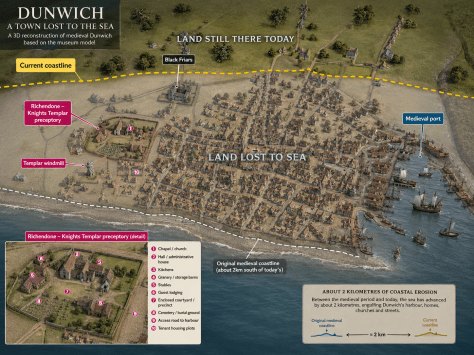
Dunwich was once one of the greatest ports on the east coast of England. In the 12th and 13th centuries it was a thriving maritime town, with a harbour, churches, religious houses, markets, streets, merchant dwellings, warehouses, wharves and ships trading across the North Sea and beyond. Its position on the Suffolk coast made it wealthy and strategically important, but also vulnerable.
Learn more about the Knights Templars in Dunwich via our blog entry click here

