JULY 2026

A surviving account from the Hospitaller estate at Halston in north-west Shropshire offers a rare view of the commandery during the closing decades of medieval religious life. Preserved at Shropshire Archives under the reference X6000/4028, the document records rents, tithes, chapel offerings, clerical salaries, household wages, clothing, kitchen costs and repairs.
Although the exact accounting year has not yet been securely identified, the script and administrative setting indicate an early-sixteenth-century date, probably within the decades preceding the suppression of the English Knights Hospitallers in 1540.
The account reveals Halston not as an isolated chapel or country estate, but as the centre of an extensive religious and economic network stretching across Whittington, Ellesmere, Oswestry, Kinnerley and the Welsh March.
The foundation of Halston
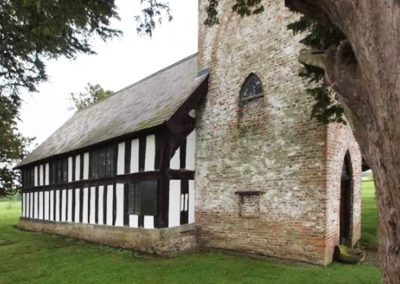
The Hospitaller house at Halston was founded between 1165 and 1187, when Roger de Powys, lord of Whittington, granted the Order part of the demesne lands that supported his own household. The original gift included land at Kinsall, Evenall, Bicket and Burley, together with rights in the woodland of Whittington. King John confirmed Roger’s grant at Rouen on 30 August 1199.
By 1338, the original territorial arrangement had apparently changed. The Hospitallers then held the tithes of Kinsall and Evenall and the great tithes of the lord’s demesne at Whittington. In return, they were obliged to provide a priest for the chapel within Whittington Castle.
Halston became the principal Hospitaller establishment serving north-west Shropshire and parts of the Welsh border country. Its officers collected income from estates, churches and dependent religious foundations, while its household supported clergy, servants, labourers and estate administrators.

The people named in the account
The account introduces a community of priests, officers, tenants and servants who lived or worked within Halston’s sphere of influence.
The opening appears to name Hugh ap Hoell, a chaplain, and John Carter, probably as accountants, receivers or local officers responsible for presenting the year’s financial statement. Hugh ap Hoell may also be the priest later described as serving the chapel connected with Whittington.
Other named officials and employees appear to include:
- Walter Bayle, apparently an important Halston officer, bailiff or receiver;
- Oliver Bayle, who received a fee during the accounting year;
- John Hamond, paid for service to the household;
- John ap Owen, apparently a household or estate servant;
- David ap Jenkin Lloyd, who carried or delivered money on behalf of the estate;
- Jenkin Carter, probably employed in transport or agricultural work;
- John, the cook, who received wages from the household;
- Edward Eyton, associated with estate expenditure or authorised business;
- John Eaton, apparently connected with repairs or the inspection of work;
- John ap Jenkin Griffith, named in relation to work on Hospitaller property.
Some names remain uncertain because the account is written in heavily abbreviated administrative Latin. They should therefore be regarded as provisional until the complete roll is transcribed from the original parchment.
Rents, arrears and tenants
A substantial part of the account records fixed rents and sums that remained unpaid from previous years. These arrears were entered against individual tenants, many of whom bore Welsh patronymic names.
Among the more legible names are forms resembling:
- Griffith ap Owen;
- Owen ap Griffith;
- Rhys ap David ap Jenkin Gough;
- Griffith ap Jenkin ap Owen;
- John ap Griffith;
- Jenkin ap Ivo;
- John of Bonaston;
- Bennett Hunt;
- Owen ap Griffith;
- Roger Hunt.
The repeated use of ap, meaning “son of,” reflects the Welsh cultural character of the district. Halston stood close to the border and administered estates populated by both English and Welsh tenants.
The tenants were not all paying the same kind of rent. The account distinguishes between money owed for:
- fixed annual rents;
- arrears carried forward from earlier accounts;
- farms or leases of land;
- tithes of grain, sheaves and hay;
- meadows and pasture;
- houses, crofts and other holdings;
- the right to collect or farm particular revenues.
Some individuals appear to have leased the produce of a tithe district rather than occupying a conventional farm. They agreed to pay Halston a fixed sum and then collected or sold the grain, hay or other produce themselves.
Whittington and its castle chapel
One of the most important responsibilities of Halston concerned Whittington Castle.

The Hospitallers received the great tithes of the lord’s demesne at Whittington and, by 1338, were required to maintain a chaplain for the castle chapel. This chapel was distinct from Whittington’s parish church, which had its own parson by about 1218 and was independently valued in the medieval taxation records.
The Halston account appears to preserve the continuation of this obligation. It records payment to a chaplain celebrating divine service at the chapel of Whittington Castle. The priest may have been Sir Hugh, possibly Hugh ap Hoell.
The title “Sir” in this context translates the Latin dominus, an ordinary courtesy title for a medieval priest. It does not mean that the chaplain was a knight.
The castle chapel would primarily have served:
- the lord and his family;
- the castle household;
- officers and servants;
- soldiers or retainers;
- visitors staying within the castle.
No securely identified remains of this chapel survive. It was probably situated within the inner part of Whittington Castle, close to the hall or residential apartments.
Halston’s own chapel and its offerings

The account also records income from offerings made at Halston itself. Receipts appear to have been collected on several important feast days, including Christmas and other major festivals of the liturgical year.
This income is entered under terms such as oblationes and offertoria, both referring to devotional offerings. These were voluntary payments made by worshippers, although the right to collect them could sometimes be leased for an agreed annual sum.
The repeated entries suggest that Halston’s chapel was used regularly and attracted worshippers on particular feast days. Offerings therefore formed a recognised source of annual revenue alongside rents and agricultural income.
The surviving timber-framed chapel at Halston stands about 350 metres south of Halston Hall. Its exact date and original function remain disputed. It has been interpreted as a late-fifteenth- or early-sixteenth-century Hospitaller chapel, a post-Dissolution domestic chapel, or a building connected with the brief Marian restoration of the Order. Extensive earthworks around it almost certainly relate to the medieval preceptory complex.

Ellesmere
The account contains a substantial section relating to Ellesmere. The Hospitaller revenues there appear to have included:
- an annual pension or fixed payment;
- tithes of grain and sheaves;
- hay;
- meadow rents;
- farms or leases;
- produce sold;
- sums charged but not successfully collected.
Some produce was sold locally, while other grain and hay may have been brought to Halston for the direct use of the household.
The account also contains marginal corrections indicating that certain sums had been entered as due but were not actually received. Such notes were an important part of medieval auditing, distinguishing expected income from cash genuinely collected.
Kinnerley, Kynaston and Treginford
The Hospitallers had acquired the rectory of Kinnerley by 1248. The original donor cannot be identified with complete certainty. The grant may have been made by Griffin Goch, an interpreter in the service of Henry II, or by his son Madoc de Sutton.
Ownership of the rectory entitled the Hospitallers to the great tithes of the parish, particularly the corn, sheaves and hay produced within its townships. In 1338 the rectory was valued at £8 annually; by 1534–35 it was valued at £20 and was specifically described as appropriated to the commandery of Halston.
The parish included Kynaston, while Treginford appears in later local records as a settlement or property within the same area. The Halston account probably records income from the agricultural tithes of this district rather than from a separate Hospitaller commandery.
There is no secure evidence that the Order maintained an independent preceptory or chapel at Kynaston. Its interest was principally in:
- rectorial tithes;
- corn and sheaves;
- hay;
- land or meadow income;
- fixed farms paid by those who leased the tithes.
Today Kynaston and Treginford remain rural settlements within Kinnerley parish. At Kinnerley, St Mary’s Church occupies the historic ecclesiastical site, although most of the present building dates from rebuilding in the eighteenth century. Its medieval west tower survived the reconstruction.
Oswestry and St John’s Hospital
Halston also possessed an important financial connection with the medieval hospital at Oswestry.
The institution was dedicated to St John and served the sick, poor and possibly lepers. Although associated at different times with both the Hospitallers and Haughmond Abbey, Halston retained a right to an annual pension.
The Halston account appears to record a payment of 20 shillings from the abbot of Haughmond. This probably represents the annual pension owed in connection with St John’s Hospital at Oswestry.
The payment demonstrates how medieval religious rights could survive even when practical administration passed to another institution. Haughmond may have managed the hospital, but Halston continued to receive an agreed annual income from it.
The hospital was not a second Hospitaller preceptory. It was a dependent charitable and religious institution from which Halston retained financial rights.
Agricultural income
Halston’s wealth depended heavily upon agriculture.
The account repeatedly refers to:
- garbae — sheaves of harvested grain;
- fenum — hay;
- prata — meadows;
- pastura — pasture;
- firma — a fixed rent or lease payment;
- exitus — issues, profits or proceeds;
- grain stored or brought into the household;
- hides, livestock or other goods sold.
Not all Hospitaller income was received in cash. Tithes could be collected in kind, especially as bundles of harvested grain. Some were sold, while others were carried to Halston and consumed by the commandery household.
The account therefore reflects two linked economies:
- a cash economy of rents, leases and pensions;
- a household economy supplied directly by grain, hay and other produce.
Chaplains and religious service
Several priests appear in the expenditure section.
The account distinguishes between:
- the chaplain of Halston;
- the priest serving Whittington Castle chapel;
- other chaplains employed for only part of the year.
Names that may be present include:
- Sir Hugh, probably Hugh ap Hoell;
- Sir William Chare or a similarly named priest;
- Sir Edmund, paid for a period of service;
- possibly Sir Geoffrey, named elsewhere among the salaried personnel.
Some chaplains entered or left service partway through the year. Their salaries were therefore calculated from one feast day to another.
The account also refers to written agreements or indentures regulating their appointments. This shows that the employment of a chaplain was a formal contractual responsibility rather than an informal arrangement.
The priests’ duties would have included:
- celebrating Mass;
- maintaining daily or regular services;
- hearing confessions;
- praying for benefactors;
- serving the preceptory household;
- fulfilling Halston’s obligation to dependent chapels.
Officers, servants and the Halston household
The commandery maintained a sizeable working household.
Payments were made to:
- receivers;
- bailiffs;
- clerks;
- chaplains;
- cooks;
- carters;
- agricultural servants;
- messengers;
- craftsmen;
- labourers;
- men supervising building work.
Some received annual fees, while others were paid wages for a quarter, half-year or other defined period.
The presence of a cook, carters and household servants indicates that Halston remained a residential establishment. It was not merely an office through which rents passed.
The carters transported grain, hay, timber and other goods. Bailiffs supervised local property and tenants. Receivers collected cash and accounted for it. Clerks maintained the records and prepared the final balance.
Clothing and livery
A separate section headed Emptio panni, “purchase of cloth,” records cloth bought by the ell for gowns and outer garments.
Recipients appear to have included priests, officers and servants. Clothing was often part of an employee’s remuneration and could also express membership of the lord’s household.
The account records:
- quantities of cloth measured in ells;
- cloth bought for individual gowns;
- garments for named servants;
- clothing for chaplains or officers;
- the total expenditure on livery.
This suggests that Halston clothed at least part of its resident workforce and maintained the outward appearance expected of an organised religious household.
Kitchen expenditure
The section headed Coquina, “the kitchen,” gives a combined sum rather than a detailed list of food.
It refers to a separate kitchen account containing the particulars. That subsidiary document may once have listed purchases such as:
- meat;
- fish;
- grain and flour;
- ale;
- salt;
- dairy produce;
- fuel;
- cooking utensils.
The existence of a separate kitchen account indicates regular and potentially substantial expenditure. Halston was feeding priests, officials, servants, guests and labourers rather than maintaining only a small resident staff.
Repairs and building work
The account includes payments for repairs to Halston and associated properties.
These expenses appear to cover:
- timber;
- transport of materials;
- wages for craftsmen;
- work on buildings;
- inspection and valuation;
- journeys made by estate officers;
- reimbursement of authorised expenditure.
Walter Bayle, Edward Eyton, John Eaton and John ap Jenkin Griffith appear in connection with financial administration or repair work, although their precise roles require further transcription.
Some sums were authorised through written obligations or certified by officers before being allowed in the account. This reflects the Hospitallers’ formal system of financial supervision.
The buildings being maintained probably included:
- the chapel;
- residential ranges;
- kitchens;
- barns and granaries;
- stables;
- agricultural structures;
- boundary works;
- dependent properties elsewhere on the estate.
Loans and money carried between officers
Near the close of the account, several sums are described as money delivered through named individuals or arising from loans.
David ap Jenkin Lloyd appears to have carried money on behalf of the commandery. Walter Bayle received several payments, perhaps because he held a senior administrative role.
These entries show that Halston’s finances involved:
- advances made before income was collected;
- reimbursement of officers;
- money transferred through trusted servants;
- balances carried from one accounting year to another.
The roll ends by comparing total receipts with total authorised expenditure. Any remaining money was entered as a debt owed by the accountant to the lord or to the Order.
Halston and the coming of the Reformation
The account presents Halston as an institution still functioning normally. Rents were collected, priests were paid, buildings repaired, servants clothed and food supplied.
Yet its world was approaching a sudden end.
The Valor Ecclesiasticus of 1534–35 recorded the revenues of English religious houses for the Crown. Halston’s possessions included the appropriated rectory of Kinnerley, income from Whittington and numerous other rents and tithes.
In 1540, Parliament suppressed the English Knights Hospitallers and transferred their property to Henry VIII. Halston’s lands, churches, tithes and pensions passed out of the control of the Order after more than three centuries.
The Hospitallers were briefly restored under Mary I, but the restoration was short-lived. Under Elizabeth I, their English religious organisation again disappeared.
A final portrait of medieval Halston
X6000/4028 records the commandery at the point where medieval religious administration met the approaching Reformation.
Its pages preserve the names of ordinary people who would otherwise be lost:
- priests celebrating at Halston and Whittington;
- bailiffs collecting rents;
- Welsh tenants owing arrears;
- cooks preparing food;
- carters transporting goods;
- servants carrying money;
- craftsmen repairing buildings.
It also reveals the remarkable reach of Halston’s authority. Its revenues came not only from its immediate demesne, but from Whittington, Ellesmere, Oswestry, Kinnerley, Kynaston and other properties across the border country.
The account should therefore be understood as more than a financial record. It is a portrait of a functioning Hospitaller community in its final years: religious in purpose, agricultural in foundation and dependent upon a complex network of tenants, chapels, churches and estates.
Within a few years, that network was broken apart by the Reformation. The buildings and lands survived, but the community that had sustained them since the twelfth century came to an end.
Learn More about the Knights Hospitallers in the UK on our main website by clicking here
Check Out out Knights Gift Store for your replica Knights Templar, Hospitaller and Order of St Lazarus Armour, weapons clothes & gifts by clicking here
 TheTemplars.Co.Uk